From Elks Lodges to Evening Mixers: The Quiet Return of the American Social Club
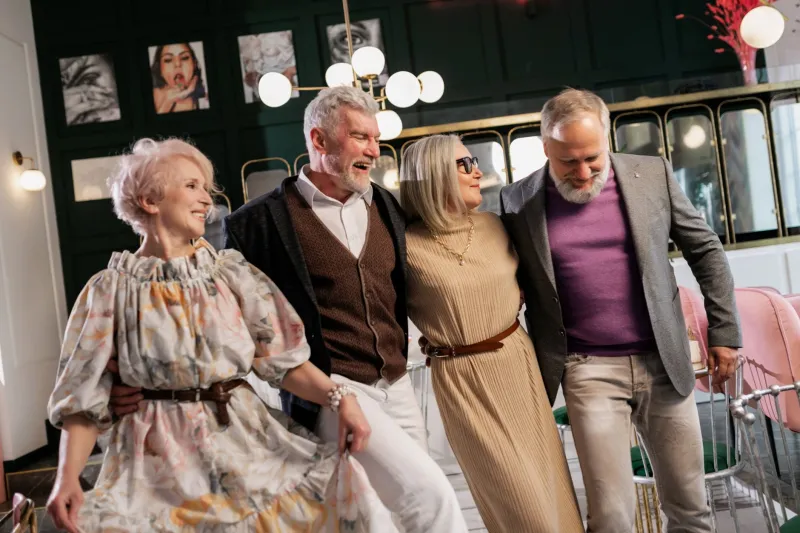
There's a photograph hanging in the back hallway of Lincoln's Club that most new members walk right past. It shows a room full of people — suits, laughter, cigarette smoke curling toward the ceiling — gathered around a long oak table somewhere in the American Midwest, circa 1952. Nobody's looking at a phone. Nobody's half-present. They're just there, completely absorbed in each other.
That image captures something we've been quietly losing for decades. And it's exactly what a growing number of Americans are now desperate to get back.
The Golden Age of Gathering
If you trace American social history back through the 19th and early 20th centuries, you'll find a country absolutely obsessed with organized community life. The Elks, the Masons, the Rotary Club, the Knights of Columbus — these weren't just places to grab a drink after work. They were the connective tissue of entire towns and cities. They funded local charities, launched political careers, brokered business deals, and — maybe most importantly — gave ordinary people a reliable sense of belonging.
By the mid-20th century, roughly half of all American adults belonged to some kind of civic or social organization. Membership wasn't a hobby. It was practically a civic duty.
Then things started to unravel.
Robert Putnam famously documented the collapse in his landmark 2000 book Bowling Alone, showing that Americans had been steadily withdrawing from community organizations since the 1960s. Television kept people home. Suburban sprawl made casual gathering harder. Two-income households left less free time. And then the internet arrived and gave everyone a convincing simulation of social life without requiring them to leave the couch.
The Digital Mirage
Here's the uncomfortable truth about online social life: it scratches the itch without actually feeding the hunger.
Research from the American Psychological Association has consistently shown that despite being more digitally connected than any generation in history, Americans — especially those under 40 — report some of the highest rates of loneliness ever recorded. The U.S. Surgeon General declared a loneliness epidemic in 2023, calling it a public health crisis comparable to smoking.
That's a stunning indictment of the assumption that social media could replace genuine community. Turns out, getting 47 likes on a photo doesn't do the same thing for your nervous system as sitting across from another human being, sharing a meal, and actually being seen.
Generation Z, ironically, seems to understand this better than anyone. Despite growing up entirely online, young adults in their 20s are now among the most enthusiastic participants in in-person community events. They didn't get enough of the real thing growing up, and they know it.
What Clubs Like Lincoln's Are Getting Right
The social clubs making a comeback in the 2020s aren't trying to recreate your grandfather's lodge — complete with rigid hierarchies and smoke-filled back rooms. The modern membership club has evolved, and that evolution is exactly what's driving its resurgence.
At Lincoln's Club, the emphasis is on accessibility and authenticity. Events range from casual happy hours and trivia nights to professional networking mixers and volunteer service days. There's no single "type" of member, and that's entirely the point. A 28-year-old graphic designer might find herself in conversation with a 55-year-old small business owner over shared interests they never would have discovered on a dating app or LinkedIn.
The physical space matters too. There's something psychologically grounding about having a regular place to go — a third place, as sociologists call it — that's neither home nor work. When you walk through the same door week after week, you start to build a kind of social muscle memory. Faces become familiar. Familiar becomes friendly. Friendly, given enough time, becomes something genuinely meaningful.
Honoring Tradition While Embracing the New
One of the most interesting tensions in the social club revival is the question of tradition. How much of the old model do you keep?
The answer, at clubs like Lincoln's, seems to be: keep the spirit, not the rigidity. The traditions worth preserving — the handshake, the shared meal, the commitment to showing up consistently — are the ones rooted in genuine human connection. The stuff that was really just gatekeeping dressed up as ritual? That can go.
This means membership structures that are welcoming rather than exclusive. It means events designed around conversation rather than performance. It means a genuine investment in making sure that the person who walks in alone on their first night doesn't walk out alone.
Why This Moment Matters
We're living through a peculiar cultural inflection point. The tools for instant connection have never been more sophisticated, and yet the hunger for genuine belonging has never felt more acute. That's not a coincidence — it's a consequence.
The good news is that the solution isn't complicated. It doesn't require an app update or a new platform. It just requires people choosing, deliberately and repeatedly, to show up for each other in the same physical space.
That's what social clubs have always offered. And if the growing membership rolls at community organizations across the country are any indication, Americans are remembering — slowly, gratefully — just how much they've been missing it.
The photograph in the hallway at Lincoln's Club isn't just nostalgia. It's a blueprint. And a whole lot of people are ready to start building again.